
Top 10 Skills Kids Gain in Coding Clubs Why Shoeburyness Families Need Them Now

A lot of children can use a phone before they can explain how any of it works. That’s not their fault. Most young people get plenty of screen time, but far fewer get the chance to make something with technology.
That’s where coding clubs matter.
For 12 to 16 year olds, a good club isn’t just “learning computers”. It’s a place to build games, fix mistakes, test ideas, work with friends, and realise that technology is something they can shape, not just consume.
School does a lot, and teachers already carry a heavy load. But clubs give young people something school can’t always offer, more time to experiment, more freedom to follow an idea, and more space to fail safely without worrying about grades.
For Shoeburyness and the wider Southend-on-Sea area, this matters even more. Some children can already access paid clubs, private lessons, kit at home, and transport. Others can’t. That gap turns into a confidence gap, then a skills gap, then an opportunity gap.
That’s why bringing a Music STEM club to shoeburyness isn’t a nice extra. It’s about giving local children a fair shot.
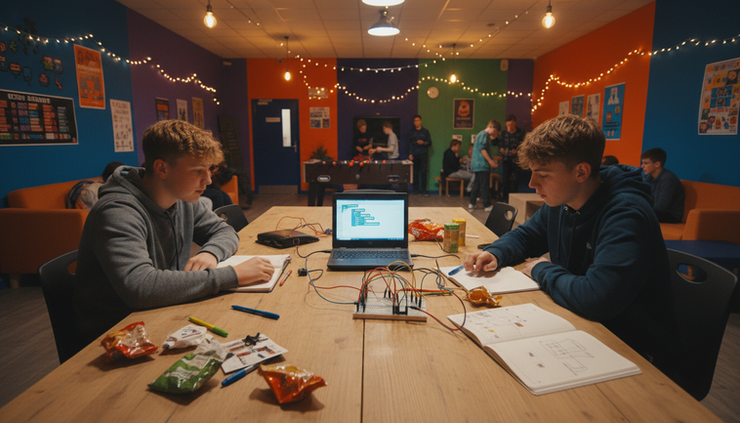
Why coding clubs work so well for 12 to 16 year olds
At this age, young people are ready for more independence. They’re asking bigger questions, testing who they are, and noticing what they’re good at.
A club gives them the chance to turn that energy into something real.
Organisations such as the Raspberry Pi Foundation, Code Club, CoderDojo, STEM Learning, and the Micro:bit Educational Foundation all support the same basic idea, young people learn best when they make things, share ideas, and solve real problems.
The Raspberry Pi Foundation’s learning resources and Code Club projects are built around hands-on making. Children don’t just read about coding. They create games, animations, websites, and small physical projects. That kind of learning is powerful because the feedback is immediate. If the game works, they know. If it breaks, they can fix it.
Families often describe similar benefits:
“They came home talking about what they’d made, not what they’d been told to do.”
“It helped my child stick with something tricky instead of giving up after five minutes.”
“They started explaining their ideas with more confidence, even outside the club.”
These are the kinds of comments families and volunteers often share after regular club sessions. The real win isn’t just the project on the screen. It’s the change in how a young person sees themselves.
The top 10 skills kids gain in coding clubs
1. They learn how to solve problems without panicking
Coding goes wrong all the time. That’s part of it.
A character won’t move. A button won’t work. A light doesn’t turn on. At first, that can feel frustrating. Then children learn to slow down, check one thing at a time, and try again.
That’s a life skill.
In school, a wrong answer can feel final. In a club, a wrong answer is usually just a clue. Young people learn that mistakes are useful, not shameful.
Practical tip
Ask after a session, “What did you fix today?” rather than “Did you get it right?”
2. They build confidence by making real things
There’s something special about watching a young person show off a game, animation, or small gadget they made themselves.
It’s not a worksheet. It’s theirs.
That ownership matters, especially for children who don’t always feel academic. Coding clubs can give them a different way to shine. A quiet child might become the one who knows how to solve a tricky bug. A child who struggles with writing might still design a brilliant game idea.
This kind of confidence sticks because it’s earned through doing.
3. They learn to keep going when something is hard
Coding clubs teach patience in a very practical way. A project might take several sessions. A small error might take ten minutes to find. A better idea might mean starting again.
That can be tough, but it’s also where resilience grows.
Young people learn that hard doesn’t mean impossible. It often means “I haven’t worked it out yet.”
This is one of the biggest benefits parents notice. The child who used to quit quickly starts giving problems one more try.

4. They practise teamwork in a low-pressure way
A good coding club doesn’t put children in rows and tell them to be silent. It usually has a nice hum to it. Someone asks for help. Someone else tests a game. Two children compare ideas.
That kind of teamwork feels natural.
Children learn to explain what they’re trying to do, listen to suggestions, share kit, and celebrate someone else’s success. They also learn that asking for help isn’t weakness.
This is especially useful for teenagers. At 12 to 16, friendships and confidence can feel complicated. Clubs give them a shared purpose, which makes talking easier.
5. They learn creative thinking through games, music, and design
Coding isn’t only about numbers and screens. It’s full of creative choices.
What should the character look like? What happens when the player wins? Can the project make a sound? Can it react to movement? Can it tell a story?
This is where coding connects beautifully with art, music, design, and drama. Some young people love making games. Others enjoy animation, sound effects, or Music Tech Clubs where they can explore beats, loops, and simple digital sound projects.
Creativity pulls in children who might not think of themselves as “techy”. They discover that coding can be a tool for imagination.
6. They understand technology instead of just using it
Most young people use apps, games, videos, and online tools every day. But using technology isn’t the same as understanding it.
Coding clubs shift that relationship.
Children start to see that every button, menu, game rule, and animation was made by someone. That’s a powerful realisation. It turns “I’m just a user” into “I could make this too.”
This matters for online safety as well. A child who understands how digital systems are built is often better placed to ask sensible questions about privacy, trust, and what happens behind the screen.
7. They develop clearer communication
When a project doesn’t work, a young person has to explain what they wanted to happen, what actually happened, and what they tried.
That’s clear communication in action.
They may not call it that, but they’re learning how to describe a problem. They’re learning how to give instructions in the right order. They’re learning how to present an idea so someone else understands it.
Those skills help in English, science, job interviews, college applications, and everyday life.

8. They learn how to help others
One of the nicest things in any club is the moment a child who was stuck last week helps someone else this week.
That’s when learning becomes community.
Helping others builds patience and pride. It also shows young people that knowledge isn’t something to keep to themselves. It’s something to pass on.
Many volunteer-led coding clubs, including those inspired by Code Club and CoderDojo, grow because older or more experienced young people support beginners. That peer support can be just as powerful as adult teaching.
9. They discover future pathways earlier
Not every child who joins a coding club will become a programmer. That’s fine.
The point is choice.
Coding connects to games, film, medicine, sport, engineering, music, transport, farming, climate work, and small local businesses. The earlier children see those links, the easier it is for them to imagine a future that includes them.
Useful places to explore include:
These organisations show how wide the world of science, technology, engineering, and maths really is.
10. They learn that they belong in tech
This might be the most important one.
A lot of children decide very early that certain subjects are “not for people like me”. That belief can come from cost, confidence, lack of access, or simply never seeing anyone local doing it.
A club can change that.
When a young person walks into a room in their own community and sees other children learning, making, laughing, and figuring things out, the message is simple.
You’re allowed to be here.
That’s especially important in under-funded areas where families may not have spare money for paid activities, transport, or kit at home. Talent is everywhere. Access isn’t.
Why Shoeburyness needs this now
Shoeburyness has brilliant young people. It also has families who are stretched, schools under pressure, and children who don’t always get the same chances as those in better-funded areas.
If a child can’t travel across town, can’t pay for a private club, or doesn’t have a laptop at home, they shouldn’t be locked out of learning skills that could shape their future.
That’s why we’re putting in the hours and resources to bring coding and programming clubs closer to home.
The aim is simple:
Give children a safe, friendly place to learn.
Keep sessions practical, not scary.
Use free and trusted learning resources where possible.
Help young people build confidence as well as skills.
Make sure cost and transport don’t become the reason a child misses out.
This isn’t about creating pressure. Children already have enough of that. It’s about opening a door.
The BBC micro:bit link and why your child could be next
The BBC micro:bit has helped many young people take their first step into physical computing, which means making code control something they can hold in their hands.
That could be a flashing badge, a step counter, a reaction game, a simple alarm, or a music project. For many children, that moment is huge. The screen stops being the whole story. Their code affects the real world.
There are also inspiring young makers and champions across the UK who have used small coding projects to solve everyday problems. Your child doesn’t need to be “top of the class” to start. They just need curiosity, encouragement, and a place to have a go.
The next young maker, helper, club leader, engineer, designer, games creator, or micro:bit champion could easily come from Shoeburyness.

Useful links for families and supporters
If you want to understand why these clubs matter, or you’d like to support one, these are good places to start:
For local families, the most useful link is the one that helps us plan real sessions for real children. If there’s a 12 to 16 year old who’d benefit, or if you can help with time, kit, space, or support, please register your interest here:
FAQ
Does my child need coding experience to join?
No. A good club starts from where each child is. Beginners are welcome, and projects can be adjusted so no one feels left behind.
What age is this for?
The focus is 12 to 16 year olds. That age group is ready for more creative projects, teamwork, and real problem solving.
What if my child doesn’t have a laptop at home?
That shouldn’t stop them. One reason for building local clubs is to reduce the gap between children who have kit at home and those who don’t.
Is coding only for children who are strong at maths?
No. Maths can help, but coding also uses creativity, patience, communication, and design thinking. Many children enjoy it because they can make something visible and fun.
Can parents or local volunteers help?
Yes. Clubs need more than technical experts. Friendly adults can help with setup, encouragement, refreshments, safeguarding support, transport planning, and spreading the word.
The real reason this matters
Coding clubs don’t just teach children to code. They teach them to try, think, build, fix, explain, and believe they have something to offer.
For Shoeburyness, that’s worth fighting for.
Some young people already get these chances. More should. If we can bring the right people, space, resources, and encouragement together, children who might never have joined a coding club can start making things they’re proud of.
And one day, one of them might be the young person others point to and say, “They started here.”
See you soon? />command_join

Comments